Browse Certification Practice Tests by Exam Family

PMI PMP 2026 Practice Test & Exam Refresh

Prepare for the July 9, 2026 PMP update with sample questions, a 180-question diagnostic, mock exams, and PM Mastery practice.

PMP 2026 refresh

Use this page if your PMP exam date is July 9, 2026 or later.

PMI's updated PMP exam puts much more weight on business environment, wider stakeholder leadership, and value-driven project outcomes, while bringing AI and sustainability into the scenario context. This is the separate PM Mastery route for that version of the exam.

Free diagnostic: try the 180-question PMP 2026 full-length practice exam before subscribing, then return here for the full practice page.

Use this page when you are preparing for the updated PMP exam launching on July 9, 2026 and want one place for PMP 2026 sample questions, practice-test style drills, and practice access on web, iPhone, or Android. It is built for learners searching for PMP 2026 mock exams, PMP 2026 practice questions, or a PMP 2026 simulator that reflects the heavier Business Environment weighting and the broader value-and-stakeholder emphasis in PMI’s refresh.

If your scheduled PMP exam date is before July 9, 2026, use the current PMP page instead. If you want a dedicated AI-management certification rather than a broad PMP refresh, compare PMI-CPMAI . If sustainability is the main target rather than a broad project-leadership exam, compare GPM-b and CSPP before choosing PMP. If your real target is project controls, cost, estimating, scheduling, risk, or construction claims, compare AACE before treating PMP 2026 as the default route.

For PMI’s official timing and published outline, see the new PMP exam page and the PMP Examination Content Outline - July 2026 PDF .

Official source check: Last checked May 5, 2026 against PMI's public PMP refresh page and July 2026 examination content outline link.

PMI's public page states that the updated PMP exam launches on July 9, 2026, uses 180 questions in 240 minutes, rebalances the domains to People 33%, Process 41%, and Business Environment 26%, and adds stronger emphasis on AI, sustainability, stakeholder engagement, outcomes, and value.

Do not use this as your primary PMP route if your scheduled exam date is before July 9, 2026. Use the current PMP practice page instead, then switch to this PMP 2026 page only if your appointment is on or after the refresh date.

Verify your exam version before you study

Before you commit your final PMP study plan, confirm the official version that applies to your scheduled exam date. This page is built for the PMP exam available globally on July 9, 2026 or later. If your appointment is before that date, use the current PMP practice page instead.

Use PMI’s official sources to verify:

  • the exam date and version that applies to your appointment
  • the current examination content outline and domain weights
  • the total item count and exam time
  • any PMI candidate guidance about updated preparation resources
  • whether your study materials explicitly reference the July 2026 outline rather than only the current PMP outline

Treat third-party summaries as secondary. They can help you interpret the refresh, but your final route choice should match PMI’s current exam page, the published content outline, and your actual appointment date.

Interactive Practice Center

Start a practice session for Project Management Professional (PMP) - July 2026 Update below, or open the full app in a new tab. For the best experience, open the full app in a new tab and navigate with swipes/gestures or the mouse wheel—just like on your phone or tablet.

Open Full App in a New Tab

A small set of questions is available for free preview. Subscribers can unlock full access by signing in with the same app-family account they use on web and mobile.

Use on iPhone or Android too: PM Mastery on the App Store or PM Mastery on Google Play using the same PM Mastery account you use on web. The same PM Mastery subscription works across web and mobile.

Free PMP 2026 diagnostic before you subscribe

Use the free PMP 2026 full-length practice exam when you want one timed diagnostic run before deciding whether to subscribe. It includes 180 original PM Mastery questions across People, Process, and Business Environment, with explanations after each item.

The free diagnostic is best used once you have reviewed the refreshed domains. For repeated timed mocks, topic drills, progress history, and the full PMP 2026 practice, open the PM Mastery web route from this page.

What this PMP 2026 practice page gives you

  • A direct route into PM Mastery practice for the July 2026 PMP update.
  • Topic drills and mixed sets aligned to People, Process, and Business Environment.
  • Detailed explanations built around best-next-step judgment, stakeholder alignment, and value-delivery trade-offs rather than memorization.
  • 24 on-page sample questions plus access to a larger PM Mastery library with 2,248 PMP 2026 practice questions.
  • A clear free-preview path before you subscribe.
  • the same PM Mastery account across web and mobile

PMP 2026 update snapshot

  • Vendor: PMI
  • Official exam name: Project Management Professional (PMP)
  • Exam version on this page: July 2026 update
  • Updated PMI prep resources available: April 14, 2026
  • New exam available globally: July 9, 2026
  • Exam code: PMP
  • Items: 180 total
  • Exam time: 240 minutes
  • Assessment style: scenario-based project leadership across predictive, agile, and hybrid environments with expanded business-environment, AI-context, and sustainability-context judgment

This refreshed PMP version shifts much more weight toward Business Environment than the current blueprint, so strong preparation needs to connect delivery decisions to governance, organizational impact, stakeholder expectations, value realization, sustainability, and AI-aware judgment instead of treating those topics like a minor appendix.

What changed and how to study differently

The PMP 2026 refresh is not just a domain-weight shuffle. It changes the kind of judgment you need to practice.

Refresh signalStudy adjustment
Business Environment is now a major domainStudy benefits, governance, compliance, value delivery, organizational change, and external constraints throughout your plan instead of saving them for final review.
AI appears as project contextPractice deciding how to use AI responsibly: approved tools, data protection, human validation, bias checks, governance, and stakeholder transparency.
Sustainability appears in scenario contextExpect trade-offs where schedule, cost, procurement, risk, compliance, and long-term impact compete.
Stakeholder engagement is broaderPractice aligning sponsors, customers, operations, compliance, vendors, and teams when their expectations conflict.
Scenario and artifact interpretation matters moreSpend less time memorizing labels and more time interpreting dashboards, decision logs, business cases, risk data, and change signals.

Decision filters for AI, sustainability, and value scenarios

Use these filters when two answers both sound reasonable. PMP 2026-style scenarios often reward the answer that keeps delivery moving while still protecting trust, governance, and the intended business outcome.

Scenario signalFirst checkStrong answer usually…Weak answer usually…
AI could accelerate the workIs the tool approved, is the data appropriate, and who validates the output?Uses AI as support, keeps human accountability, verifies assumptions, and communicates limitations.Treats AI output as automatically correct or bypasses privacy, security, or stakeholder review.
Sustainability creates a trade-offWhich requirement, constraint, or long-term impact changes the decision?Evaluates options transparently and balances schedule, cost, risk, compliance, and long-term value.Treats sustainability as optional when delivery pressure increases.
Benefits are unclearWhat measurable outcome justified the project?Reconnects decisions to the business case, benefits owner, success criteria, and adoption plan.Reports activity, velocity, or completed scope without confirming value.
Stakeholders disagreeWhat decision criteria would let the group choose responsibly?Facilitates alignment, documents the decision, assigns owners, and communicates next steps.Escalates too early or lets the loudest stakeholder drive the project.
A governance constraint appearsWho must approve, be informed, or provide evidence?Follows the decision path and records the rationale before changing commitments.Moves fast by ignoring required approvals or evidence.

Why the refresh deserves a separate PMP landing page

PMI changeWhat that means for practice
More emphasis on impact and valueYou need scenario practice that links execution choices to benefits, business case outcomes, and whether the work was worth the effort and expense.
Business Environment rises from 8% to 26%You cannot leave governance, compliance, organizational context, and external-environment judgment for the end of your study plan.
Leadership expands beyond team managementExpect more stakeholder alignment, communication strategy, customer expectations, reporting, and governance-process decisions.
AI and sustainability appear in contextPractice needs to test how you evaluate tools, trade-offs, risks, controls, and long-term implications inside a live project scenario.
Newer case/scenario and graphic-based item formats appear in the exam updateYour prep should feel more like interpreting real project information, not just answering short isolated prompts.

Which PMP page should you use?

Your situationStart hereWhy
Testing on or after July 9, 2026PMP 2026The refresh weighting and scenario emphasis change on that date.
Testing before July 9, 2026PMPThe current PMP blueprint is still the one that matters for your exam date.
Need deep AI-governance and AI-operations coveragePMI-CPMAIBetter fit if your role is centered on AI initiative management rather than broad PMP coverage.
Need the current shorter PMI sustainability routeGPM-bBetter fit if your target is the 75-question GPM-b route rather than broad PMP coverage.
Need the newer practitioner-path sustainability routeCSPPBetter fit for PRiSM, P5, sustainability-management planning, ESG reporting, and governance.
Need project-controls, cost, scheduling, risk, or claims depthAACEBetter fit if your target is CCP, CEP, EVP, PSP, PRMP, DRMP, CFCC, CCT, or CST rather than broad PMP coverage.

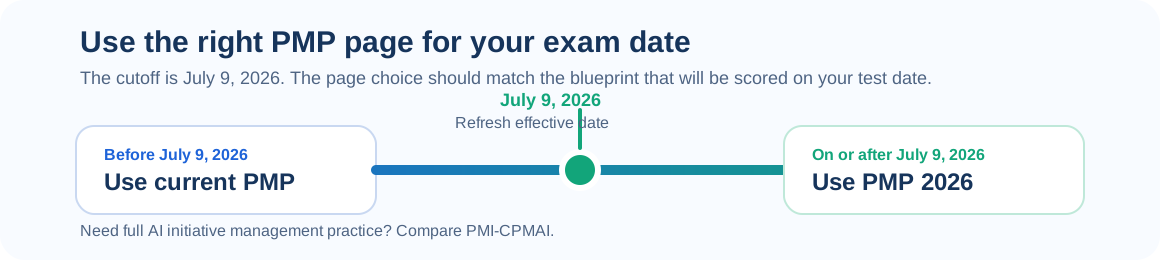
PMP cutover at a glance

Timeline showing that exam dates before July 9, 2026 should use the current PMP page and exam dates on or after July 9, 2026 should use the PMP 2026 page.

Topic coverage for PMP 2026 practice

DomainWeightTarget items (out of 180)
People33%59
Process41%74
Business Environment26%47

Focused PMP 2026 drill paths

Use the domain pages when a full mixed mock tells you where the weakness is. Each page keeps the generated questions separate from the custom guidance, so the drill content can refresh while the study advice stays stable.

If your misses cluster around…Use this focused pathWhat to watch while reviewing
Team conflict, stakeholder pressure, communication, coaching, or servant leadershipPeople, Teams, and Stakeholder LeadershipWhether the best answer builds trust, aligns expectations, and removes friction without taking over the team’s work.
Planning, change, risk, quality, delivery method, metrics, or AI-assisted executionProcess, Delivery, and AI-Aware ExecutionWhether the answer uses the right control, artifact, cadence, or validation step for the situation.
Benefits, compliance, governance, sustainability, adoption, or organizational changeBusiness Environment, Value, and ChangeWhether the answer protects the business case and real-world outcomes instead of only the delivery plan.
Timing, endurance, and mixed-domain switching180-question full-length diagnosticWhether you can sustain judgment across all three domains without relying on answer recognition.

Current PMP vs PMP 2026

DomainCurrent PMPPMP 2026 refreshWhat that means for practice
People42%33%Team leadership still matters, but it is less dominant than in the current exam.
Process50%41%Delivery-control questions remain central, but they no longer take half the exam.
Business Environment8%26%Governance, organizational impact, AI-aware judgment, and sustainability move from light coverage to a major scoring area.

PMP 2026 readiness map

Use this map when reviewing missed questions. The fastest improvement usually comes from naming the decision pattern behind the miss, not from memorizing the explanation.

DomainWhat the refreshed exam is really testingWhat PM Mastery practice should force you to decideCommon wrong-answer trap
PeopleLeadership that keeps stakeholders, teams, and customers aligned through conflict and ambiguityWhether to coach, facilitate, negotiate, document, escalate, or remove an impedimentEscalating too early, choosing a command-and-control answer, or optimizing only for the team while ignoring external stakeholders
ProcessDelivery control across predictive, agile, and hybrid workWhich artifact, metric, cadence, risk response, quality step, or change path is useful nextNaming a process artifact without using it to solve the actual delivery problem
Business EnvironmentWhether the project is still valuable, compliant, adoptable, and strategically alignedHow to protect benefits, governance, compliance, sustainability, AI controls, and organizational change while still deliveringTreating business context as background noise and choosing the answer that only protects scope, cost, or schedule

How to use the PMP 2026 simulator efficiently

  1. Start with domain drills so you can see where the refresh actually changed your weak spots, especially in Business Environment.
  2. Review every miss until you can explain how the best answer balances delivery, governance, stakeholder alignment, value, AI-related judgment, and sustainability implications.
  3. Move into mixed sets once you can switch cleanly between team leadership, process control, and organization-level decision scenarios without losing the business outcome.
  4. Finish with longer timed runs so the new weighting and richer scenario context do not surprise you under exam pressure.

Final 10-day practice sequence

This is a practical finish plan once you already know the refreshed domains and need to convert practice into exam readiness.

WindowWhat to doWhat not to do
Days 10-7Take one mixed timed set or the full diagnostic, then classify every miss by decision pattern: people, process, value, governance, compliance, AI, sustainability, or timing.Do not simply reread explanations and mark everything as understood.
Days 6-4Drill the weakest domain page, especially Business Environment if value, compliance, or stakeholder trade-offs are costing points.Do not chase random volume if your misses are concentrated in one pattern.
Days 3-2Take another varied timed attempt and check whether the same mistake patterns are shrinking.Do not keep repeating a set whose answers you recognize.
Day 1Light review only: formulas if needed, wrong-answer traps, timing plan, exam logistics, and rest.Do not start a new large question run late enough that fatigue becomes the main result.

Exam-day execution habits

Use your final practice runs to rehearse how you will behave during the real exam, not only what you know.

HabitWhy it matters on PMP 2026
Read the last sentence first when a prompt is longIt tells you whether the item asks for next action, best interpretation, root cause, risk response, or stakeholder approach.
Name the constraint before choosingMany refreshed scenarios turn on governance, compliance, AI controls, sustainability, business value, or stakeholder trust.
Eliminate answers that bypass accountabilityFast answers that skip approval, validation, facilitation, or human oversight are often traps.
Mark and move when two answers remain closeLong scenario exams punish over-investing early. Return after easier items have protected your score.
Review changed answers only with a reasonChange an answer when you find a missed requirement or constraint, not because the second reading feels less familiar.

When practice is enough

The goal is not to memorize the largest possible question bank. The goal is to build transferable judgment so you can handle new PMP scenarios under time pressure.

If you can complete several varied timed attempts above your readiness threshold, for example 75% or higher, and you can explain why the best answers are better than the tempting alternatives, it is usually time to move toward the real exam instead of repeating the same style of questions indefinitely. More practice still helps when it targets weak domains, but repeating questions you already recognize can inflate confidence without improving exam-day reasoning.

Use PM Mastery to find and repair weak spots. Once your misses are narrow, your timing is stable, and your explanations are sound, switch from “more questions” to final review, rest, and exam execution.

Free preview vs premium

  • Free preview: 24 sample questions on this page plus a free web preview so you can validate the question style and explanation depth before you subscribe.
  • Premium: the full PMP 2026 practice, focused drills, mixed sets, timed mock exams, detailed explanations, and progress tracking across web and mobile.

Cutover FAQ

QuestionPractical answer
My exam is before July 9, 2026. Should I use this page?Use the current PMP practice page as your primary route. This page is for the refreshed exam launching July 9, 2026.
My exam is after July 9, 2026. Should I switch now?Yes. Treat the 2026 route as your primary path so Business Environment, value delivery, AI context, sustainability, and refreshed scenario style are built into your practice early.
Is AI a separate PMP domain?No. Treat AI as scenario context that affects governance, data handling, tool selection, human validation, risk, and stakeholder communication.
Is sustainability a separate PMP domain?No. Treat sustainability as a constraint and value consideration that can affect procurement, risk, compliance, benefits, and long-term impact decisions.
How should I use the 180-question diagnostic?Take it after a first domain review, not as your first exposure. Use the result to decide which domain drills to repeat before longer timed mocks.

How PMP 2026 questions feel

Many PMP 2026-style questions are not asking, “Which term do you remember?” They are asking, “What should a project leader do next when value, governance, delivery, and stakeholders pull in different directions?”

Example decision pattern:

Scenario clueWhat it usually means
A sponsor wants speed, but compliance or privacy constraints are unresolvedDo not bypass governance. Clarify constraints, evaluate options, and get the right decision recorded.
An AI tool could accelerate work, but data or accuracy risks existUse approved tools, minimize sensitive inputs, keep a human validation step, and communicate limitations.
Stakeholders disagree about what “success” meansFacilitate alignment around measurable outcomes and decision criteria before pushing execution.
A project is on time but benefits look weakReconnect the work to the business case, benefits owner, and value measures instead of celebrating schedule alone.

When eliminating answer choices, prefer the option that preserves value and trust while still moving the work forward. Be cautious with answers that sound efficient but ignore compliance, stakeholder alignment, human validation, benefits ownership, or the documented decision path.

If you need…Best page
The current PMP blueprint before the July 9, 2026 cutoverPMP
A dedicated AI initiative management credentialPMI-CPMAI
A dedicated PMI sustainability credentialGPM-b or CSPP
A project-controls, cost, scheduling, risk, or claims credentialAACE
Scrum Master guidance for AI-enabled facilitation and team supportPSM-AI
Product Owner guidance for AI-enabled backlog and value decisionsPSPO-AI
Broader AI-driven project delivery and adoption patternsAIPM

24 PMP 2026 sample questions with detailed explanations

These sample questions reflect the same scenario-heavy judgment you should practice for PMP 2026. Use them to check your readiness here, then continue in PM Mastery with mixed sets, topic drills, and timed mocks while you also prepare for the updated exam’s wider case/scenario and graphic-based item mix.

These are original PM Mastery practice questions. They are not PMI exam items, are not copied from any exam sponsor, and should be used to practice decision patterns rather than memorize exact wording.

Question 1

Topic: Domain I: People

You are leading a hybrid digital transformation project with a distributed team. A key impediment is blocking a release: Legal requires customer data to remain in-country, while Sales insists the same release must include a new AI-driven personalization feature that would use a cloud service not yet approved. Both stakeholders are escalating and giving the team conflicting direction.

As the project manager, what should you do to collaborate with stakeholders, agree on an approach, and resolve the issue? (Select TWO)

  • A. Update the issue log with agreed owners, due dates, and decision points, then communicate the documented decision and next steps to affected teams
  • B. Facilitate a time-boxed working session with Legal and Sales to define decision criteria, evaluate options, and agree on a compliant path forward
  • C. Escalate immediately to the sponsor for a decision without attempting stakeholder alignment
  • D. Decide on the best technical solution yourself and inform stakeholders to avoid further delays
  • E. Use an AI assistant to generate a recommendation and send it to stakeholders without review to speed up alignment
  • F. Proceed with the AI feature using the cloud service and address compliance concerns after release

Best answers: A, B

Explanation: The impediment is driven by conflicting stakeholder constraints, so the priority is to create shared understanding and reach an explicit agreement on how to proceed. A facilitated decision discussion helps stakeholders align on criteria and trade-offs, while documenting owners, dates, and decisions ensures follow-through and reduces future rework or renewed disagreement.

When an issue is caused by conflicting stakeholder direction, effective removal of the impediment starts with collaboration to converge on a decision that respects constraints (such as legal/compliance) while optimizing value. Facilitation techniques (time-boxing, clear decision criteria, options with impacts) help stakeholders move from positions to an agreed approach.

Once alignment is achieved, convert it into execution by recording the issue, decision, owners, and due dates, then communicating the outcome to the teams impacted. This maintains transparency, supports governance/audit needs, and prevents the team from receiving mixed signals.

By contrast, unilateral decisions, skipping alignment, or bypassing compliance increases risk and typically prolongs the blockage.


Question 2

Topic: Domain III: Business Environment

You are initiating a hybrid project to launch an AI-enabled customer support portal. The sponsor asks you to finalize measurable benefits and success criteria that align with the approved business case.

Exhibit: Business case + draft success criteria (excerpt)

Strategy objective: Reduce support cost while improving customer experience.
Target benefit (12 months post-launch): cost/contact from \$6.20 to \$4.80; NPS from 32 to 40.
Draft success criteria:
SC1: Portal uses an AI chatbot for tier-1 questions.
SC2: Support agents feel the portal is easy to use.
SC3: Cost/contact \$4.80 and NPS 40 by 12 months post-launch.
SC4: Deploy portal by Q3 with no major defects.

Which draft success criterion best meets the sponsor’s request?

  • A. Accept SC4
  • B. Accept SC1
  • C. Accept SC3
  • D. Accept SC2

Best answer: C

Explanation: Measurable benefits and success criteria should be outcome-based, quantified, and time-bound, and they must trace directly to the business case and strategy. The business case defines target improvements to cost per contact and NPS within 12 months, so the success criterion should use those exact measures and time horizon to enable benefits tracking.

Success criteria for value-based delivery should be defined in measurable, verifiable terms and aligned to the business case’s intended outcomes (benefits), not just solution features or team sentiment. In the exhibit, the business case specifies two outcome metrics (cost/contact and NPS) and a time window (12 months post-launch). A fit-for-purpose success criterion therefore restates those targets as measurable thresholds so the team can baseline, track, and confirm benefits realization after implementation.

Key checks to make criteria measurable and aligned:

  • Use outcome metrics from the business case (not features)
  • Specify numeric targets and a measurement timeframe
  • Ensure the metric can be verified from agreed data sources

The strongest criterion is the one that enables objective validation of the stated benefits, rather than describing delivery activities or subjective opinions.


Question 3

Topic: Domain II: Process

You are leading a hybrid digital-transformation project with a requirements traceability matrix (RTM) linking stakeholder needs to requirements, design components, test cases, and expected outcomes. After a stakeholder workshop, the product owner updates several high-priority backlog items, but the team does not update the RTM.

What is the most likely near-term impact of this inaction?

  • A. Benefits realization will likely be missed in the first year
  • B. A regulatory audit will result in immediate financial penalties
  • C. Final project costs will exceed the approved budget baseline
  • D. Reduced ability to identify impacted deliverables and verification work

Best answer: D

Explanation: Requirements traceability preserves a clear line from stakeholder needs to requirements, deliverables, and validation activities. If the RTM is not updated after changes, the team loses fast, reliable impact analysis. The immediate consequence is confusion about what work and verification must change, increasing near-term rework and missed acceptance checks.

Requirements traceability ensures every requirement and outcome is linked back to a stakeholder need and forward to the deliverables and verification/validation artifacts that prove it was met. When changes occur but the RTM is not updated, the team cannot quickly determine what design elements, acceptance criteria, test cases, or dependent work items are affected.

Near-term, this typically shows up as:

  • Incomplete change impact analysis during planning
  • Misaligned build/test work in the next iteration or phase
  • Rework when gaps are discovered during reviews or testing

The closest distractors describe downstream effects that may happen later, but the immediate impact is the loss of visibility needed to adjust deliverables and verification work correctly.


Question 4

Topic: Domain II: Process

A distributed hybrid team is handing off a digital product to an operations group. You must publish a clear summary of the last three sprint reviews (decisions, open risks, and runbook updates) to the project knowledge base within 24 hours. The raw notes include customer PII and negotiated contract rates.

Your organization allows AI summarization only in a company-approved secure tenant, requires removing sensitive data before processing, and requires a human validation step before publishing.

What should you do to best optimize speed while meeting these constraints?

  • A. Redact sensitive data, summarize in approved AI, then human-validate
  • B. Paste notes into a public AI tool; remove names only
  • C. Assign manual summarization only to avoid AI-related risks
  • D. Use AI to auto-publish the summary directly to the wiki

Best answer: A

Explanation: The objective is fast knowledge transfer without breaching confidentiality or publishing unverified content. The best approach applies responsible AI use: minimize/clean the input, use only the approved secure environment, and keep a human-in-the-loop to validate accuracy and appropriateness before sharing. This satisfies governance requirements while still accelerating documentation.

Responsible AI-assisted summarization for project documentation means balancing speed with governance: protect confidential information and ensure the output is accurate before it becomes an organizational record. In this scenario, the notes contain PII and contract rates, and the organization explicitly requires (1) using only an approved secure AI environment, (2) removing sensitive data before processing, and (3) human validation before publishing. Redacting sensitive content reduces exposure, using the approved tenant meets confidentiality controls, and having a knowledgeable reviewer confirm key decisions/risks ensures the summary is trustworthy for the operations handoff. Skipping approval, skipping redaction, or skipping human review breaks stated constraints even if it seems faster.


Question 5

Topic: Domain II: Process

You are the project manager for a hybrid rollout of a new customer portal. The team is preparing to close Phase 1 (pilot) and move to the next phase, but the sponsor, operations, and compliance have different expectations for what “done” means. A formal phase-gate sign-off is required.

Which action should the project manager NOT take when defining and confirming exit criteria for this phase closure?

  • A. Create an acceptance checklist with evidence for each criterion
  • B. Close the phase when all pilot backlog items are completed
  • C. Obtain formal sign-off from sponsor and operations on criteria
  • D. Facilitate a workshop to align and document exit criteria

Best answer: B

Explanation: Exit criteria must be explicitly defined, agreed with the right stakeholders, and objectively verified with evidence before a phase or project can be closed. Treating “work completed” in a plan or backlog as equivalent to meeting exit criteria bypasses acceptance and governance expectations. The correct approach is to align, document, and confirm the criteria and then validate them during closure.

Exit criteria are the agreed conditions that must be met to close a project or phase and pass control to the next stage or the receiving organization. In the scenario, stakeholders disagree on what “done” means, so the project manager should make the exit criteria explicit, measurable, and owned by the appropriate decision makers (e.g., sponsor, operations, compliance), then confirm them through objective evidence.

A practical approach is to:

  • Facilitate alignment on the criteria and who approves them
  • Document criteria in the phase-gate/acceptance artifact
  • Define the evidence (tests, audits, sign-offs) that proves each criterion
  • Verify completion and obtain formal acceptance before closure

The closest trap is equating completion of planned scope with acceptance of outcomes.


Question 6

Topic: Domain II: Process

You are preparing this week’s steering committee status update for a hybrid digital transformation project. Based on the exhibit, what is the best way to communicate project status clearly, accurately, and transparently?

Exhibit: Weekly status snapshot
S1 (Status date): May 31
S2 (EVM): PV \$200k; EV \$180k; AC \$210k
S3 (Indices): CPI 0.86; SPI 0.90
S4 (Milestone M3 - UAT start): Planned Jun 10; Forecast Jun 24
S5 (Issue ISS-07): Data migration defects; high; vendor fix ETA Jun 14
S6 (Change CR-03): Add AI fraud rules; +3 weeks; decision pending
  • A. Report the project is on track because EV is close to PV
  • B. Report only ISS-07 to avoid alarming stakeholders with metrics
  • C. Delay the status update until CR-03 is approved or rejected
  • D. Report S3, S4 slip, S5 impact, and request a CR-03 decision

Best answer: D

Explanation: Clear and transparent status communication summarizes current performance and the forward-looking forecast using objective data, then highlights key drivers and decisions needed. Here, the indices and milestone forecast show the project is underperforming versus plan, and the issue and pending change explain why and what leadership must decide next.

Transparent status communication is fact-based and decision-oriented: present current performance, explain key causes, show the forecasted impact, and identify actions/decisions needed. In the exhibit, S3 indicates cost and schedule efficiency are below plan, and S4 confirms a material milestone slip. S5 provides a concrete driver and ownership for recovery, while S6 signals a governance decision that can change the baseline and should be surfaced explicitly.

A strong update typically includes:

  • Current performance indicators (e.g., S3)
  • Forecasted delivery impact (e.g., S4)
  • Top issues/risks with owners and dates (e.g., S5)
  • Decisions/approvals required and by when (e.g., S6)

Avoid optimistic summaries that contradict the data or withholding information to “reduce concern.”


Question 7

Topic: Domain I: People

A hybrid team is implementing a new customer self-service portal for a global retailer. Mid-project, the sponsor announces a compliance-driven change: the solution must use a different identity provider, adding uncertainty to the release plan. Several regional sales leaders are already skeptical and ask for a live Q&A. To “avoid distraction,” the project manager sends a brief email update and postpones any discussion until the next monthly steering meeting.

What is the most likely near-term impact of this decision?

  • A. The team delivers faster because fewer stakeholders provide input
  • B. The identity provider contract is terminated for nonperformance
  • C. Stakeholder rumors and objections increase, and workshop participation drops
  • D. The program fails benefits realization due to poor adoption after launch

Best answer: C

Explanation: When stakeholders are resistant and uncertainty increases, postponing dialogue removes the primary mechanism for maintaining trust and alignment. In the near term, unanswered questions turn into assumptions, and stakeholders disengage from working sessions where decisions and requirements are shaped. The immediate consequence is increased noise and reduced participation, making resistance harder to manage.

The core concept is proactive stakeholder engagement during change: resistance is best managed with timely, two-way communication, active listening, and visible responsiveness. In this scenario, the change creates uncertainty, and skeptical stakeholders explicitly request interaction; sending a one-way email and deferring discussion signals that concerns are not being prioritized. The typical near-term effect is an increase in informal channels (rumors, side escalations, repeated objections) and a drop in participation in workshops where shared understanding is built.

Practical moves that prevent this include:

  • Hold a short live Q&A to surface concerns and correct misinformation
  • Explain what is known vs. unknown and how decisions will be made
  • Confirm impacts, owners, and next updates in a visible engagement plan

This immediate engagement protects trust now, even if schedule impacts are still being analyzed.


Question 8

Topic: Domain II: Process

You are starting a hybrid project to implement an AI-assisted claims triage platform for a regulated insurance provider. Constraints:

  • The PMO requires an approved risk management plan to pass the initiation gate in 5 business days.
  • The organization has an enterprise risk policy, but thresholds and escalation paths must be tailored per project.
  • The steering committee expects a monthly risk report highlighting any risks above tolerance.

What is the BEST next action?

  • A. Start populating the risk register and assign owners later
  • B. Facilitate risk planning to tailor roles, thresholds, and reporting
  • C. Produce the plan yourself using AI, then circulate for comments
  • D. Ask the PMO to provide a standard plan and submit unchanged

Best answer: B

Explanation: Before logging and managing individual risks, you need a fit-for-purpose risk management plan that defines how risk work will be done on this project. Given the initiation gate and steering committee expectations, the plan must explicitly set roles, thresholds/escalation, and a reporting cadence aligned to the enterprise risk policy. A facilitated planning session with key stakeholders is the fastest way to tailor and gain alignment.

The core concept is planning risk management: defining and tailoring the project’s risk approach so risk identification, analysis, response, and monitoring are consistent, auditable, and aligned to governance. In this scenario, the initiation gate requires an approved plan quickly, and the steering committee expects reporting based on tolerance, so you must explicitly define who does what and when risks are escalated.

A practical next step is to convene a short risk planning workshop (sponsor/steering rep, compliance/ERM, product owner, key leads) to:

  • Tailor the risk process to the hybrid delivery approach
  • Assign roles (risk owners, escalation authority)
  • Define thresholds/tolerance triggers and escalation paths
  • Define reporting format and cadence for monthly governance

Using templates or AI can help draft content, but stakeholder alignment and approval are essential for the plan to be actionable and to pass the gate.


Question 9

Topic: Domain III: Business Environment

You are leading a hybrid project to modernize a financial services customer portal. The distributed team wants to use generative AI to speed up analysis and testing, but governance has not been defined.

Exhibit: Risk register (excerpt)

R1: Team pasted client incident logs into a public AI tool; data exposure risk = High
R2: AI-generated test cases missed edge conditions; rework risk = Medium
R3: AI vendor terms say prompts/outputs may be retained; IP risk = High
Owner for R1-R3: Project manager; Response: TBD

Based on the exhibit, what is the best next action to establish appropriate AI tool usage governance for this project?

  • A. Proceed with AI use as planned and add an action item to review outputs if defects increase
  • B. Create an AI usage standard that addresses R1-R3: approved tools and data-class rules, mandatory human review/validation, and legal-approved IP/retention terms
  • C. Prohibit any AI use on the project until after project closure
  • D. Accept R1-R3 because the schedule benefit outweighs the risks and document the decision in meeting minutes

Best answer: B

Explanation: The risk register shows unresolved, high-impact risks tied to confidentiality (R1), accuracy and human oversight (R2), and IP/retention terms (R3). The best governance response is to define and implement clear AI usage rules that control what data can be used, require human validation of outputs, and ensure legal-approved terms for IP and data retention before continued use.

AI tool governance is part of project governance because it defines decision rights, guardrails, and controls needed to deliver value while meeting legal and compliance obligations. Here, R1 indicates a confidentiality/data-handling gap, R2 shows a need for explicit human oversight and accuracy validation, and R3 requires IP and vendor-terms review.

A fit-for-purpose next action is to establish and socialize an AI usage standard for the project that includes:

  • Allowed/approved tools and environments; prohibited data classes
  • Mandatory human review, validation, and traceability for AI-assisted work
  • Legal/procurement approval of vendor terms covering IP ownership and prompt/output retention

This resolves the “Response: TBD” governance gap rather than relying on informal reminders or risk acceptance.


Question 10

Topic: Domain II: Process

You are finalizing the cost baseline for a hybrid digital-transformation project before a governance gate this week. A risk workshop produced three high-priority, independent cost risks, and the sponsor asked you to justify the contingency amount to include in the baseline.

Exhibit: Cost risk estimates (USD)

R1: 25% probability; cost impact \$120,000
R2: 10% probability; cost impact \$400,000
R3: 35% probability; cost impact \$60,000

What is the best next step?

  • A. Add $580,000 contingency by summing all potential impacts
  • B. Ask the sponsor to approve $91,000 management reserve immediately
  • C. Begin implementing responses for all three risks now
  • D. Compute EMV and set contingency reserve to $91,000

Best answer: D

Explanation: Quantitative risk analysis can be used to size contingency when probability and impact estimates are available. Calculating expected monetary value (EMV) for each independent risk and summing them provides a defensible contingency reserve amount to include in the cost baseline. Here, the EMV total is $91,000.

When you have reasonable probability and impact estimates, the appropriate next step is to quantify contingency needs using EMV so the baseline is supported by data rather than worst-case assumptions. For independent cost risks, compute each risk’s EMV as probability \(\times\) impact, then sum EMVs to estimate the contingency reserve needed for known-unknowns.

  • R1: \(0.25 \times 120{,}000 = 30{,}000\)
  • R2: \(0.10 \times 400{,}000 = 40{,}000\)
  • R3: \(0.35 \times 60{,}000 = 21{,}000\)
  • Total contingency reserve: \(30{,}000 + 40{,}000 + 21{,}000 = 91{,}000\)

After quantifying, you can incorporate this contingency into the baseline and explain the assumptions, rather than escalating prematurely or funding the full worst case.


Question 11

Topic: Domain II: Process

You are managing a hybrid project (predictive infrastructure work plus agile product increments). The executive dashboard shows green status based on CPI/SPI from timesheets, but sprint reviews repeatedly miss committed features and defect rework is increasing. When you compare reports, you find product teams track progress in story points in an agile tool, while finance converts hours to “% complete” differently by team, with no documented reconciliation.

What is the most likely underlying cause of the inconsistent status signals?

  • A. The team is underperforming due to low productivity
  • B. Schedule variance is being caused by excessive defect rework
  • C. Metrics and reconciliation methods were not defined to align with the hybrid approach and goals
  • D. The reporting tools are inaccurate and need replacement

Best answer: C

Explanation: The symptoms point to a measurement design problem: different parts of the hybrid project are using incompatible progress measures (hours/% complete vs story points) with no agreed translation or reconciliation. Effective status evaluation requires metrics, analysis, and data reconciliation that fit the delivery approach and are traceable to the project’s goals and outcomes.

In hybrid environments, status can diverge when metrics are not intentionally designed to work together. Here, predictive cost/schedule indicators are being produced from timesheets and locally defined “% complete,” while delivery progress is managed in story points with rising rework. Without agreed metric definitions (what “complete” means), data sources of record, and a reconciliation method (how agile delivery evidence maps to progress and forecasts), the project can report favorable CPI/SPI while missing feature commitments and accumulating quality debt.

A fit-for-purpose approach is to baseline what each audience needs (value/features, predictability, cost), then define a small, consistent metric set and reconciliation rules (cadence, owners, and how variances are analyzed and explained) so all reports tell the same story.


Question 12

Topic: Domain II: Process

On a hybrid digital transformation project, a change request to add a new regulatory reporting feature is approved by the change control board. The project manager updates the scope, schedule, and cost baselines, reprioritizes items in the product backlog, revises the project management plan, and communicates the updates so the team can start the new work.

Which governance concept is being applied?

  • A. Perform integrated change control
  • B. Validate scope
  • C. Perform configuration management
  • D. Plan risk responses

Best answer: A

Explanation: The scenario describes what happens after a change is approved: the project manager incorporates it into the controlled project artifacts (plans, baselines, and backlog) and ensures the team is aligned to execute it. That is the essence of integrated change control-authorizing and then integrating approved changes into the project’s current, governed plan of record.

Integrated change control is the governance mechanism used to manage change requests through decision-making and then to implement approved changes by updating the appropriate project documents. In this scenario, the change is already approved, so the key behavior is integration: updating scope, schedule, and cost baselines (as applicable), updating the project management plan, adjusting the backlog for delivery, and communicating the new authorized direction so work can proceed under the updated baselines.

The distinguishing feature is that the approved change becomes part of the official plan of record (and backlog in agile/hybrid), maintaining traceability and control.


Question 13

Topic: Domain II: Process

You are managing a hybrid project delivering a regulated customer portal. The team is distributed and uses shared cloud storage plus a Git repository.

During a change-control review, the compliance lead finds that the test evidence references “Requirements_v7,” while development is building to “Requirements_v6 (final),” and the design document in the shared folder has an untracked “v6.2” edit. Work has already started on the requested change, and the sponsor wants an impact estimate within 48 hours.

What should you do NEXT?

  • A. Approve the change request immediately and then update all documents to the newest version after the next release
  • B. Escalate to the steering committee to decide which document version should be used going forward
  • C. Ask each team lead to confirm their latest local copy and email it to you so you can reconcile differences
  • D. Run a configuration audit to identify the last approved versions, label/baseline them in the repository, and restrict edits to controlled check-in/check-out

Best answer: D

Explanation: Before estimating or continuing change work, you need a single source of truth for the current approved baselines. A configuration audit followed by labeling/baselining and controlled access in the version-control system restores traceability and prevents further divergence. This enables accurate impact analysis and supports compliance evidence.

The core need is configuration management: keeping deliverables and key artifacts uniquely identified, versioned, and traceable to approved baselines. With multiple uncontrolled versions in circulation, any impact estimate (and any continued work) is unreliable and may fail an audit.

The best next step is to:

  • Identify the last formally approved versions of key artifacts
  • Baseline/label those versions in the authoritative repository
  • Enforce controlled updates (check-in/check-out, permissions, and change linkage)

Once configuration is under control, you can confidently analyze the proposed change against the correct baseline and maintain an auditable trail from change request to updated artifacts.


Question 14

Topic: Domain I: People

A project manager wants to set clear expectations with the team and key stakeholders about how disagreements will be handled (for example, escalation paths, collaboration norms, and acceptable behaviors). Which artifact is used to document and communicate these conflict management principles and expectations?

  • A. Issue log
  • B. Team charter
  • C. Stakeholder engagement plan
  • D. Communications management plan

Best answer: B

Explanation: The team charter is the artifact used to formalize and communicate how the team will operate, including behavioral expectations and agreed approaches for handling conflict. By documenting ground rules and conflict resolution norms early, the project manager sets a shared standard the team and stakeholders can reference when disagreements occur.

Conflict management expectations are most effective when they are explicit, agreed, and visible. The team charter is a core artifact used to establish the team’s operating guidelines (often called ground rules or working agreements), which can include how decisions are made, what respectful behavior looks like, and how conflicts are raised, facilitated, and escalated. Because it is created collaboratively and shared, it helps prevent misunderstandings and provides a common reference point when tensions arise.

Key takeaway: plans about communications or stakeholders support the environment, but the team charter is where the team’s conflict-handling norms are formally agreed.


Question 15

Topic: Domain II: Process

You are leading a hybrid project delivering a new customer self-service portal. Two weeks before the planned launch, the QA team confirms that a third-party payment API change is causing intermittent transaction failures in UAT, which could violate PCI compliance and delay go-live if not resolved.

What is the best immediate action to manage this situation?

  • A. Approve a schedule extension now to protect quality without further analysis
  • B. Log it as an issue, assess impact, assign an owner, and escalate as needed
  • C. Add it to the risk register and review it at the next risk meeting
  • D. Ask the team to work overtime to fix it and avoid escalation

Best answer: B

Explanation: This is an issue (it is already happening) with potential impacts to delivery, quality, and regulatory compliance. The best immediate response is to capture it formally, quickly assess its impact and priority, assign a single accountable owner, and escalate promptly if decision authority or external coordination is required.

Issue management starts by treating confirmed, current impediments as issues (not risks) and making their impact visible and actionable. Here, intermittent payment failures in UAT directly threaten product quality (defects), delivery (launch date), and outcomes (PCI compliance and customer trust). The project manager should log the issue so it is traceable, perform a rapid impact assessment (scope/schedule/cost/compliance and operational impacts), prioritize it, and assign an owner to drive resolution with the vendor and internal teams. Because compliance and launch commitments are at stake, escalation to the appropriate governance or decision authority may be necessary to secure vendor support, approve changes, or adjust release criteria. The key takeaway is to make the issue owned, analyzed, and governed before choosing a response path.


Question 16

Topic: Domain III: Business Environment

You are leading a hybrid digital-transformation project to automate customer onboarding across three regions. The steering committee will approve continued funding at the next governance gate in 6 weeks.

Constraints:

  • Compliance requires audit-ready evidence of reduced onboarding errors.
  • Operations wants a 20% reduction in average onboarding cycle time.
  • The CFO wants measurable cost-to-serve improvement within 2 quarters of release.
  • Sales wants no drop in conversion during rollout.

Several stakeholders are proposing success measures, but they are not aligned. What is the best next action?

  • A. Ask each function to submit its own KPIs and track all of them to avoid conflict
  • B. Adopt standard project metrics (schedule variance, CPI, SPI) to keep governance objective
  • C. Facilitate a workshop to define outcome-based KPIs, baselines, targets, and data sources, then document them as gate criteria
  • D. Defer success metric definition until after the first regional release to use real production data

Best answer: C

Explanation: The governance gate requires clear, agreed-upon measures of value and outcomes, not a collection of disconnected metrics. A focused facilitation session to define KPIs with baselines, targets, and data sources ensures the metrics are aligned to compliance, operations, finance, and sales needs and can be used as approval criteria in 6 weeks.

Success metrics should reflect outcomes and value delivery that matter to key stakeholders and governance, and they must be measurable and traceable. In this scenario, the next gate is soon and requires audit-ready evidence and business impact measures across multiple functions. The best next step is to collaboratively define a small set of aligned KPIs with clear operational definitions (what is measured), baselines (current performance), targets (desired improvement), and data sources/owners (how evidence will be produced). Documenting these as gate criteria (and in the benefits/measurement plan) makes expectations explicit, reduces later disputes, and ensures the project can demonstrate compliance and value without waiting for subjective interpretations.

The key takeaway is to align and operationalize outcome metrics early enough to drive decisions at governance gates.


Question 17

Topic: Domain II: Process

A project must pass periodic regulatory audits. The project manager implements unique IDs for key decisions and work products, stores them in a controlled repository with version history, and links each change to its approval record so an auditor can reconstruct who approved what and when.

Which governance concept does this practice BEST represent?

  • A. Benefits realization governance
  • B. Risk governance and escalation management
  • C. Stakeholder engagement governance
  • D. Configuration management with an auditable change history

Best answer: D

Explanation: The described setup creates an audit trail by controlling versions of project artifacts and explicitly linking changes and decisions to approvals. That is the purpose of configuration management within project governance: ensure integrity, traceability, and transparency of key work products over time. This enables audits to validate what changed, why, and who authorized it.

The core concept is configuration management (often paired with formal change control) to keep key artifacts and decisions traceable, transparent, and auditable. In practice, this means identifying configuration items (e.g., baselined requirements, plans, designs), controlling versions in a governed repository, and ensuring each change is tied to an approval record (who/when/why). These controls allow reconstruction of decision paths and artifact evolution during audits, support compliance, and reduce ambiguity about the “current approved” state. In contrast, stakeholder, risk, and benefits governance are important but do not primarily create an end-to-end audit trail for artifact versions and decision approvals.


Question 18

Topic: Domain III: Business Environment

You are leading a hybrid project to deploy an AI-assisted customer onboarding workflow across two regions. The executive sponsor asks to move the go-live up by four weeks to capture market share, but the compliance lead warns that KYC/AML and data-privacy approvals may be impacted if testing is reduced. The product owner says the team could either add contractors (increasing cost) or defer some “nice-to-have” features (reducing scope).

Before proposing a tradeoff, what should you ask/verify FIRST?

  • A. What is the detailed cost estimate for adding contractors
  • B. Which compliance approvals and quality criteria are mandatory for go-live
  • C. What is the team’s historical velocity and defect trend
  • D. Which backlog items can be removed to meet the earlier date

Best answer: B

Explanation: Start by clarifying the hard constraints that cannot be traded off, especially regulatory approvals and minimum quality/acceptance criteria. Once those guardrails are confirmed, you can present feasible options (e.g., add budget, reduce scope, or keep the date) that stay compliant and meet required quality.

Balancing expectation tradeoffs requires establishing the decision boundaries first: which constraints are fixed and which are negotiable. In scenarios involving regulated releases, compliance approvals and minimum quality/acceptance criteria typically act as “hard constraints” that define what options are even possible. Without confirming the required approvals, controls, and acceptance thresholds for go-live, any proposed acceleration plan risks being infeasible or noncompliant.

After clarifying these mandatory constraints, you can evaluate realistic alternatives (e.g., add resources to protect quality, adjust scope to protect schedule, or re-sequence work) and negotiate stakeholder expectations based on transparent impacts to schedule, budget, and value.


Question 19

Topic: Domain II: Process

You are leading a hybrid delivery project to deploy a customer onboarding platform across three regions. Constraints: a regulatory audit is in 8 weeks, budget is fixed (no new vendors), and governance requires traceable issue decisions for weekly steering committee updates.

In the last two iterations, the distributed teams repeatedly report the same blockers (access approvals and data-masking rules). Workarounds are increasing defects, and several blockers remain open with no clear owner. What is the BEST next action?

  • A. Create an impediment board, assign owners, review daily, and escalate
  • B. Reduce scope by deferring compliance-related features to a later release
  • C. Escalate all blockers to the sponsor for immediate decisions
  • D. Run a retrospective at the end of the next iteration

Best answer: A

Explanation: The situation shows recurring, aging blockers with no ownership, causing quality impacts and risking the audit timeline. Establishing an explicit impediment management cadence (visibility, owners, target dates, and escalation) enables continuous reassessment and ensures obstacles are actively addressed while meeting governance traceability needs.

The core need is continuous reassessment so impediments don’t linger, recur, or get “worked around” in ways that harm quality and compliance. With a fixed audit date and traceability requirements, the best next action is to make impediments visible, assign accountable owners, and inspect them frequently with a clear escalation path.

A fit-for-purpose approach is:

  • Capture blockers in a shared impediment/issue log with owner and due date
  • Review and reprioritize them in daily syncs (and before key handoffs)
  • Escalate unresolved items via the defined governance path
  • Close the loop by updating status in weekly steering updates

This directly addresses the repeated access and data-masking blockers while creating an auditable record of decisions and actions.


Question 20

Topic: Domain II: Process

You are managing a hybrid digital transformation project with two distributed delivery teams. In the next 6 weeks, several high-priority items require a shared security architect (available 2 days/week) and a shared data engineer (available 3 days/week). Work is starting but repeatedly blocking while waiting for these specialists.

Which TWO actions should you take to better match resources to priorities and minimize bottlenecks? (Select TWO)

  • A. Pair specialists with capable team members to offload routine tasks and build backup capacity
  • B. Replace the shared security architect immediately with a contractor and skip onboarding to save time
  • C. Authorize overtime for the specialists until the blocking stops
  • D. Timebox specialist capacity to the highest-priority, dependency-driving work and defer lower-priority items that require them
  • E. Use an AI assistant to generate security designs and deploy them without specialist review
  • F. Start all specialist-dependent items now so teams stay busy and self-organize around waits

Best answers: A, D

Explanation: When a few specialists constrain flow, the project manager should allocate their limited capacity to the highest-priority, dependency-driving work and prevent lower-priority work from consuming the constraint. In parallel, reduce the bottleneck by increasing usable capacity at the constraint through pairing and knowledge transfer so more work can progress without waiting.

Resource optimization focuses on managing constraints: assign scarce resources to what most advances project objectives and reduce queues that create waiting and rework. In this scenario, the security architect and data engineer are the limiting resources, so you should deliberately schedule their time to the highest-priority items that unlock other work, and defer or limit starting lower-priority items that would compete for the same specialists. You should also increase throughput at the constraint by enabling others to take on well-defined portions of specialist work through pairing, templates/checklists, and guided knowledge transfer.

These actions directly reduce blocked work and improve flow without relying on unsustainable short-term fixes.


Question 21

Topic: Domain II: Process

You are leading a hybrid project to deliver an AI-assisted customer support platform. The product features will be refined through 2-week iterations with frequent stakeholder feedback.

Constraints:

  • Regulatory requirements must be met; deliverables require formal acceptance.
  • The sponsor needs a firm spending limit for governance reporting.
  • The seller will provide a blended team (engineers, UX, data specialist), and effort is hard to estimate until discovery is complete.

What is the BEST next action when selecting the contract type for this procurement?

  • A. Use time and materials with a not-to-exceed ceiling and iteration-based acceptance
  • B. Use firm fixed price for the full solution to shift risk to the seller
  • C. Use cost plus fixed fee to maximize flexibility during discovery
  • D. Use fixed price incentive fee for the full scope with a single final acceptance

Best answer: A

Explanation: With adaptive delivery and uncertain effort, a contract should allow scope refinement without forcing premature estimates. Time and materials fits this need, and adding a not-to-exceed ceiling aligns with governance demands for a firm spending limit. Iteration-based acceptance supports compliance through frequent, documented approvals of increments.

Contract type selection should align with how well scope can be defined and which party should carry cost and performance risk. In an iterative approach where requirements and solution details will emerge during discovery, locking a full-scope fixed-price agreement typically drives heavy upfront specification, change disputes, or inflated pricing to cover uncertainty. Time and materials is commonly fit-for-purpose when the seller is providing a capacity-based team and level of effort is uncertain.

Adding a not-to-exceed (ceiling) amount addresses the sponsor’s governance need for cost containment while still enabling iterative delivery and formal acceptance of increments. The key takeaway is to match contract risk allocation to scope certainty: higher uncertainty favors flexible contract structures with clear controls, not full-scope fixed pricing.


Question 22

Topic: Domain II: Process

You are managing a hybrid digital-transformation project with a distributed team. Your governance standard states: every open High-impact issue must have a named owner, a current status, and a specific escalation trigger (resolved items may show n/a).

Exhibit: Issue log (excerpt)

ID Impact Owner Status Escalation trigger
ISS-21 High - Open -
ISS-22 Medium Data lead In work If open > 5 business days
ISS-23 High Vendor PM In work If SLA breach likely
ISS-24 Low Scrum master Resolved n/a

Based on the exhibit, what should you do first to properly maintain the issue log?

  • A. Add an escalation trigger to ISS-24 because every issue must be escalatable
  • B. Reassign ISS-23 from the vendor PM to the project sponsor
  • C. Update ISS-21 with a named owner and a specific escalation trigger
  • D. Change ISS-22 to High impact because it has a time-based trigger

Best answer: C

Explanation: An issue log stays actionable when each open, high-impact issue has clear accountability and a defined point at which governance escalation occurs. In the exhibit, the only open High-impact item missing required fields is the entry with no owner and no escalation trigger. Updating that record first restores traceability and enables timely escalation.

Maintaining an issue log means keeping each issue traceable and decision-ready, especially for high-impact impediments. For open High-impact items, the minimum control information is: a single accountable owner, an up-to-date status, and an explicit escalation trigger that signals when the issue must move to a higher authority (e.g., sponsor/steering committee) for decision or support.

In the excerpt, ISS-21 is High impact and still Open, yet it has no named owner and no escalation trigger. Before problem-solving, the project manager should correct the log entry so accountability and escalation are unambiguous and the issue can be managed through the agreed governance path.

The key takeaway is to fix missing ownership/trigger fields first so the issue can be actively managed and escalated when needed.


Question 23

Topic: Domain II: Process

A hybrid project has delivered its final increment and the sponsor has accepted the deliverables. During closure, you learn that some vendor invoices may arrive after the contract closeout date and your organization’s governance requires finance to confirm all liabilities before any unused contingency is released.

What should you do NEXT to reconcile and close the financials and release remaining reserves per governance?

  • A. Reconcile actuals with finance, include accruals for pending invoices, then release unused contingency after sign-off
  • B. Ask the sponsor to approve releasing reserves and let finance reconcile costs afterward
  • C. Release all unused reserves now and handle any late invoices as operational expenses
  • D. Use an AI cost-forecast tool to produce a final estimate and release reserves based on the forecast

Best answer: A

Explanation: To close project financials, the project manager must ensure all costs and remaining liabilities are captured and validated. Because governance requires finance confirmation before releasing unused contingency, you should complete final reconciliation (including accruals for late invoices) and obtain the required sign-off. Only then should remaining reserves be released through the approved process.

Project closure financials are finalized when actual costs are reconciled and all remaining obligations are recognized so the organization can accurately report the project’s final cost. In this scenario, the deciding factor is the governance requirement: finance must confirm liabilities before any unused contingency is released.

A fit-for-purpose next step is to work with finance to:

  • Confirm all posted actuals
  • Identify outstanding commitments and record accruals for expected late invoices
  • Obtain finance approval per the closeout checklist
  • Release any unused contingency through the approved change/closeout process

Forecasts (even AI-assisted) and sponsor preference do not replace required financial reconciliation and approval controls.


Question 24

Topic: Domain III: Business Environment

A hybrid team is delivering a new AI-enabled self-service portal as part of a customer experience transformation. After three releases, usage is growing, but the COO says the work is “not moving the needle” on the strategic goal of reducing customer churn.

Clues:

  • The product owner prioritizes backlog items by effort and stakeholder requests, not by expected churn impact.
  • Status reports highlight features completed and velocity, with no benefits/KPIs tracked.
  • Regional leaders are asking for different “must-have” features, and the sponsor is considering pausing funding.

What is the most likely underlying cause of the situation?

  • A. Benefits and success measures are not aligned to the strategic objective
  • B. The team is experiencing scope creep from too many feature requests
  • C. End users were not trained enough on the new portal
  • D. Stakeholders are resisting the change and causing low adoption

Best answer: A

Explanation: The key clue is the disconnect between the stated strategy (reduce churn) and how decisions and reporting are made (features, effort, and velocity). Without outcome-based measures and a benefits focus, prioritization becomes request-driven and executives cannot see or realize strategic value. Aligning KPIs and benefits to strategy is the primary issue driving the symptoms.

This is a benefits alignment and value-delivery problem: the organization’s strategic objective (reduce churn) is not being translated into measurable outcomes that guide prioritization and governance. When a project reports only outputs (features completed, velocity) and ranks work by effort or stakeholder requests, it can deliver “more” while still failing to deliver the intended business value.

To diagnose and correct this, the project should:

  • Define outcome-based success criteria (e.g., churn drivers, leading indicators)
  • Link backlog items/features to expected benefits and validate assumptions
  • Use benefits/KPI reporting to steer trade-offs and funding decisions

The competing regional requests and possible funding pause are consequences of missing outcome alignment, not the root cause.

PMP 2026 refresh decision map

Use this map after the sample questions to connect individual items to the PMP refresh themes: AI, sustainability, outcomes, stakeholder engagement, adaptive delivery, and value-focused leadership.

    flowchart LR
	  S1["PMP 2026 scenario"] --> S2
	  S2["Identify delivery approach and emerging constraint"] --> S3
	  S3["Assess AI sustainability stakeholder and value impact"] --> S4
	  S4["Choose ethical adaptive leadership response"] --> S5
	  S5["Update plan risk or benefit measure"] --> S6
	  S6["Communicate outcome and learning"]

Quick Cheat Sheet

CueWhat to remember
AI-aware deliveryUse AI to support decisions, not to remove accountability or verification.
SustainabilityConsider long-term impacts, constraints, benefits, and stakeholder expectations.
OutcomesPrefer decisions that protect value and benefits over activity completion alone.
StakeholdersEngagement is active listening, collaboration, influence, and expectation management.
AdaptationTailor predictive, agile, and hybrid approaches to complexity and uncertainty.

Mini Glossary

  • AI governance: Policies, controls, accountability, data practices, and human oversight for AI-enabled work.
  • Value delivery: Creating outcomes that matter to customers, users, sponsors, and the organization.
  • Stakeholder engagement: Identifying, analyzing, communicating with, and involving people affected by the work.
  • Hybrid approach: Combines predictive and adaptive practices based on delivery context and risk.
  • Benefits realization: Confirming that delivered outputs create the intended business outcomes and value.

Need concept review first?

If you want concept-first reading before heavier simulator work, use the companion PMP 2026 Study Guide on PMExams.com. Then return here for timed mocks, topic drills, explanations, and the full PM Mastery practice route.

Focused sample questions

Use these child pages when you want focused PM Mastery practice before returning to mixed sets and timed mocks.

In this section

Revised on Thursday, May 14, 2026