PMI-CPMAI Practice Test
Prepare for PMI-CPMAI with a stable, domain-mapped PM Mastery bank, public sample questions, a free-practice page, responsible AI, business framing, data readiness, model evaluation, governance, and operations drills.
Use PM Mastery for interactive practice with timed mocks, focused drills, progress tracking, and detailed explanations across web and mobile. The free-practice page and web app preview show how practice handles AI business framing, data readiness, model evaluation, responsible governance, release controls, and operational monitoring.
Choose PMI-CPMAI when you need an AI initiative management exam rather than a general PM exam. This route is strongest when you own the AI business case, data readiness, model evaluation, governance, rollout, and monitoring. If you mainly need broad project-leadership prep with some AI context, compare PMP 2026 . If your role is specifically Scrum Master or Product Owner, compare PSM-AI and PSPO-AI .
Practice preview
Use this page to start the web app before longer mixed practice. For a public question-style check, use the quick review and the free-practice page in this exam section; the interactive app remains the primary practice path.
- cheat sheet : High-yield AI project review; practice with explanations.
- Free practice exam : Try 120 free PMI-CPMAI questions across the exam domains, with answers and explanations, then continue in PM Mastery.
What this PMI-CPMAI practice page gives you
- A direct web entry for PMI-CPMAI practice in PM Mastery.
- Topic drills and mixed sets across responsible AI, business needs, data needs, model evaluation, and operationalization.
- Detailed explanations that show why the best AI-delivery answer is right under real constraints.
- A full-length free-practice page plus interactive PMI-CPMAI practice in PM Mastery.
- A clear web preview path for previewing question style before deeper practice.
- The same PM Mastery account across web and mobile
PMI-CPMAI exam snapshot
- Vendor: PMI
- Official exam name: PMI Certified Professional in Managing AI (PMI-CPMAI)
- Exam code: PMI-CPMAI
- Items: 120 total
- Exam time: 160 minutes
- Assessment style: scenario-based AI project delivery, governance, data, and operational decisions
PMI-CPMAI questions usually reward the option that balances business value with governance, data realism, validation discipline, and safe operational rollout.
Which AI-related PM exam should you choose?
| If your role is closest to… | Best page | Why |
|---|---|---|
| End-to-end AI initiative leadership | PMI-CPMAI | Strongest fit for business framing, data readiness, model evaluation, governance, rollout, and monitoring. |
| Mainstream PMP credentials with AI context | PMP 2026 | Best if your target is broad PMP preparation with AI context rather than a dedicated AI credential. |
| Scrum Master or agile coach work | PSM-AI | Better fit for facilitation, team support, and AI inside Scrum events. |
| Product Owner work | PSPO-AI | Better fit for discovery, backlog quality, prioritization, and value decisions. |
| Broader AI-enabled project delivery | AIPM | Better fit if you want a wider AI project-delivery route beyond PMI’s AI-management framing. |
AI delivery loop you should recognize
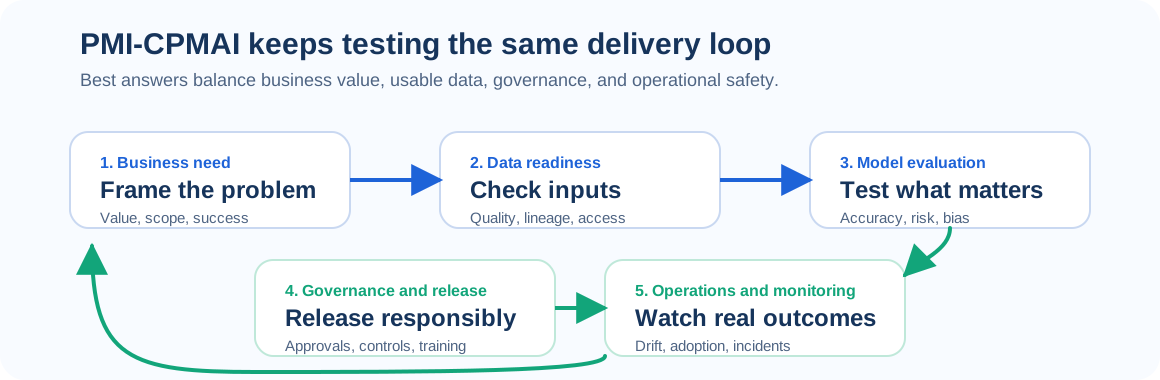
The exam keeps circling through the same logic: frame the business problem correctly, confirm the data is usable, evaluate the model with the right success measures, release under governance controls, then monitor and improve in production.
Topic coverage for PMI-CPMAI practice
| Domain | Weight |
|---|---|
| Support Responsible and Trustworthy AI Efforts | 15% |
| Identify Business Needs and Solutions | 26% |
| Identify Data Needs | 26% |
| Manage AI Model Development and Evaluation | 16% |
| Operationalize AI Solution | 17% |
PMI-CPMAI decision filters for AI scenarios
AI exam scenarios often include tempting technical answers. Use these filters to keep the decision tied to value, evidence, governance, and safe operation.
| Scenario signal | First check | Strong answer usually… | Weak answer usually… |
|---|---|---|---|
| Leaders request an AI solution before defining the problem | Business need and measurable outcome | Clarifies the decision, value measure, constraints, and success criteria before choosing a model | Starts tool selection or model development because AI has executive attention |
| The model performs well in a lab but adoption is weak | Workflow, change impact, and stakeholder readiness | Addresses process fit, user trust, auditability, training, and accountability before scaling | Tunes accuracy only and treats adoption as a post-launch communication issue |
| Data quality issues appear during preparation | Data suitability and traceability | Stops or gates progress until requirements, lineage, privacy, and quality checks are satisfied | Proceeds to training because the team can compensate during modeling |
| Accuracy metrics look promising but harm is possible | Responsible AI controls | Adds risk review, bias testing, explainability, human oversight, and approval gates appropriate to impact | Uses one aggregate metric as proof the solution is ready |
| A pilot is ready for production | Operational readiness | Confirms SLOs, monitoring, rollback, support ownership, model drift checks, and incident response | Moves to production because the pilot met functional acceptance criteria |
| Performance degrades after launch | Monitoring and continuous improvement | Investigates drift, data changes, feedback loops, and retraining triggers under governance | Retrains immediately without diagnosing the cause or approval path |
PMI-CPMAI readiness map
Use this map after each timed set to classify the miss before you do more questions.
| Domain | What the exam tests | What PM Mastery practice should force | Common trap |
|---|---|---|---|
| Responsible and Trustworthy AI | Whether governance, risk, transparency, fairness, privacy, and oversight match the solution impact | Choose controls proportionate to stakeholder harm, data sensitivity, and decision criticality | Treating responsible AI as a checklist after model selection |
| Business Needs and Solutions | Whether the AI initiative is solving the right problem with measurable value | Translate vague AI interest into outcomes, success measures, constraints, and route-fit decisions | Optimizing for technical novelty instead of business value |
| Data Needs | Whether data is fit for purpose, legal, representative, traceable, and operationally available | Spot gaps in lineage, consent, quality, bias, feature readiness, and governance | Assuming more data is automatically better |
| Model Development and Evaluation | Whether evaluation design matches the use case and risk profile | Compare metrics, validation methods, test data, human review, and go/no-go evidence | Choosing the highest metric without checking failure cost |
| Operationalize AI Solution | Whether the solution can run safely in production | Connect deployment, monitoring, support, drift, rollback, feedback, and retraining decisions | Treating launch as the finish line |
How to use the PMI-CPMAI simulator efficiently
- Start with focused drills on business framing, data readiness, and responsible AI before mixing in later lifecycle decisions.
- Review every miss until you can explain the trade-off between feasibility, governance, value, and operational reliability.
- Move into mixed sets once you can connect business need, data quality, model evaluation, and deployment planning in one scenario.
- Finish with timed runs so you can keep sound judgment under pressure instead of chasing technically impressive but risky answers.
Final 7-day PMI-CPMAI practice sequence
Use the final week to rehearse AI-delivery judgment, not to memorize model terminology.
| Timing | Practice focus | What to review after the set |
|---|---|---|
| Days 7-5 | One full-length self-check plus targeted drills in the weakest lifecycle domains | Whether misses came from business framing, data readiness, evaluation criteria, responsible AI, or operationalization |
| Days 4-3 | Mixed AI lifecycle sets with exhibits, constraints, and stakeholder decisions | Whether you can explain why the safest valuable next step is better than the most technical answer |
| Days 2-1 | Light review of governance gates, data checks, evaluation choices, monitoring, and rollback language | Only recurring traps; do not introduce unfamiliar AI frameworks late |
| Exam day | Warm up with a few scenario items if useful | Read for the lifecycle stage first, then choose the answer that improves evidence, value, and control |
When PMI-CPMAI practice is enough
Use varied mixed attempts to identify weak topics, correct guesses and answers you recognize. A practice percentage is not a validated prediction of passing; compare your work with the current official outline and use the study and review guidance to plan the next step. Continuing to repeat the same large bank can become overtraining: you may remember item patterns while losing the habit of reasoning from the business problem, data evidence, model risk, and production constraint.
Web preview and premium practice
- Web/public preview: a smaller web set so you can validate the question style and explanation depth.
- Premium: interactive web-app practice with focused drills, mixed sets, timed mock exams, detailed explanations, and progress tracking across web and mobile.
PMI-CPMAI AI project map
Use this map after a free-practice page, quick review, or mock exam to connect practice items to AI project methodology, data readiness, model lifecycle, governance, risk, stakeholder adoption, and responsible-AI decisions.
    flowchart LR
	  S1["AI project lifecycle scenario"] --> S2
	  S2["Define business problem and data context"] --> S3
	  S3["Assess model risk governance and feasibility"] --> S4
	  S4["Choose iteration experiment or control step"] --> S5
	  S5["Validate outcome adoption and ethics"] --> S6
	  S6["Monitor model and business performance"]
Mini Glossary
- AI governance: Policies, controls, accountability, data practices, and human oversight for AI-enabled work.
- Prompt risk: Risk that AI output is unreliable, biased, incomplete, insecure, or unsuitable for the decision context.
- Risk: Uncertain event or condition that can affect objectives positively or negatively.
- Stakeholder engagement: Identifying, analyzing, communicating with, and involving people affected by the work.
- Value delivery: Creating outcomes that matter to customers, users, sponsors, and the organization.
In this section
- PMI-CPMAI — PMI Certified Professional in Managing AI Cheat SheetCheat sheet: PMI-CPMAI reference for AI project lifecycle, governance, risk, data, modeling, deployment, and exam decision points.
- PMI-CPMAI — PMI Certified Professional in Managing AI Study PlanA practical study plan for PMI-CPMAI candidates, with 7-day, 14-day, 30-day, and 60/90-day schedules plus mock exam and review guidance.
- PMI-CPMAI — PMI Certified Professional in Managing AI Exam BlueprintPractical PMI-CPMAI exam blueprint for candidates preparing for PMI Certified Professional in Managing AI exam readiness.
- PMI-CPMAI — PMI Certified Professional in Managing AI Scenario Practice GuideRead PMI-CPMAI scenarios, isolate AI project decision points, and choose defensible next actions under governance, risk, and delivery constraints.
- Free PMI-CPMAI Full-Length Practice Exam: 120 QuestionsTry 120 free PMI-CPMAI questions across the exam domains, with answers and explanations, then continue in PM Mastery.
- PMI-CPMAI — PMI Certified Professional in Managing AI Official ResourcesVerify PMI-CPMAI official sources for exam rules, version status, eligibility, booking, and how to pair them with practice.